
Last updated: September 14, 2026
Key Takeaways
- Za’atar is a blend, but the word also names a plant, Origanum syriacum, which is neither oregano nor thyme.
- Levantine za’atar is built on that dried herb with sumac, toasted sesame and salt, usually four to six ingredients.
- Turkish za’atar, often called zahter, is built on roasted chickpeas, sesame, melon seeds and terebinth, and contains no thyme at all.
- Edi’s Turkish-style za’atar runs to thirteen ingredients, is milled to a fine powder, and contains peanuts, wheat and sesame.
- The two blends are not versions of each other and do not substitute for each other in cooking.

Open two bags labelled za’atar and you may find almost nothing in common.
One is green and flaky and smells like a dry hillside in August. The other is a fine brown powder that smells roasted — closer to a jar of nut butter than to a herb.
Both are correct. Neither is a knock-off of the other.
That is the part nobody explains, and it is the reason the same word can land you two bags that have almost nothing to do with each other.
What’s Actually in Za’atar
Most ingredient lists stop at four items. Thyme, sumac, sesame, salt.
That list is accurate. It is also half the picture.
The Levantine blend — the one most Canadians meet first — is a dried herb carrying sumac for tartness, toasted sesame for fat and crunch, and salt. Some versions add marjoram or oregano. Good ones are mostly herb by volume, which is why they read green in the bag.
Turkish-style za’atar has no thyme in it whatsoever.
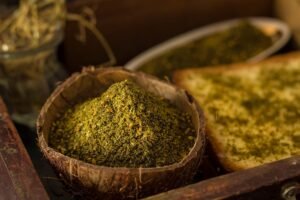
Here is Edi’s full list, as printed on the pouch: roasted chickpeas, watermelon seeds, melon seeds, terebinth, peanuts, boiled wheat, sesame, fennel, coriander, sumac, cumin, red pepper, and salt. Thirteen ingredients. It contains peanuts, wheat and sesame.
Roasted chickpeas and boiled wheat give it body. Melon and watermelon seeds carry the fat. Terebinth carries a resinous pine-citrus note nothing else in the blend can produce.

All of it is milled fine. Where the Levantine blend is leafy and flaky, this one is a dense powder closer in texture to a nut flour.
Sumac does the same job in both traditions — it is the tart, deep-red element, and it is the one ingredient the two blends genuinely share.
Think of dried oregano next to ground almonds. Both go on food, both come in a bag, and nobody would use them the same way.
That is the gap between a dried-herb blend and a ground seed blend. Same word on the label. Different thing in the bowl.
Why There Are Two Za’atars
The trouble starts with the word, because it does two jobs at once.
Za’atar is a plant. Origanum syriacum is a Mediterranean subshrub whose native range runs from the eastern Mediterranean to the Arabian Peninsula, per Kew’s Plants of the World Online. It is not oregano and it is not thyme, though it grows in the same family and tastes like an argument between the two.
Za’atar is also a blend named after that plant.
In Lebanon, Syria, Jordan and Palestine, the blend keeps the herb at the centre. That is the green za’atar, and it is old.
Cross into southeast Anatolia — Gaziantep, Şanlıurfa, Hatay — and the same word points somewhere else. Locals often say zahter. The herb steps back and roasted seeds, legumes and terebinth step forward.
Terebinth is the tell. It is a wild relative of the pistachio, known in Turkish as menengiç, and it is the reason a Turkish blend smells roasted rather than herbal.

Neither tradition borrowed from the other. They grew up in the same region and went different directions with the same name.
Arguing about which one is the real za’atar is a bit like arguing that a Montreal bagel is a failed New York bagel. They are not trying to do the same job.

If you have seen the terms green za’atar and red za’atar: green means herb-forward, red usually means a heavier hand with sumac. Both describe blends within the Levantine family. Neither describes the Turkish one, which is brown because it is roasted.
What Za’atar Tastes Like
“Savoury, tangy and earthy” is what most descriptions give you. That is the flavour equivalent of calling a song musical.
The green Levantine blend tastes herbal and slightly grassy, with sumac cutting a sharp line through it and toasted sesame underneath. It is bright. It wakes a dish up.
The Turkish blend does something else entirely. Roasted chickpeas and seeds give it a toasted, almost nutty base, melon seeds bring a faint sweetness, and terebinth leaves a resinous pine note at the back.
Sumac arrives last in both, the way lemon zest does in a dressing — not the first thing you taste, but the thing that stops the fat sitting flat.
The grind matters. Because it is milled fine, it disperses through olive oil instead of sitting on the surface in flakes.

People often arrive at za’atar asking what it does to them. It is a seasoning, not a supplement, and a spice blend is not the right place to look for that answer.
What it can tell you is what is in it. Salt is in almost every za’atar, Edi’s included, so season the dish after tasting rather than before.
What to Put Za’atar On
The green blend sits on top of things. This one goes into them.
A fine grind disperses through olive oil rather than floating in it. Stir a spoonful into oil and you get a dense, smooth paste rather than a scatter, and it coats a surface evenly instead of in patches.
The oldest use is still the best argument for keeping a bag in the cupboard: a shallow dish of olive oil, a spoon of za’atar stirred through it, torn bread for dipping.
Manakish is the other classic. Dough spread with za’atar and oil, baked until the edges blister, and add cheese for the version most bakeries sell.

The green blend is leafier, so it is usually added late. The ground one takes being rubbed into meat before cooking and comes out fine.
If You Can’t Find Za’atar
Every substitute recipe on the internet hands you the same three things: dried thyme, sumac, sesame seeds. Mix and done.
For the green Levantine blend, that is a fair approximation. You will not get Origanum syriacum out of a supermarket thyme jar, but you will get something in the neighbourhood.
Against the Turkish blend it is not an approximation at all. It is a different recipe that happens to share a name.
You cannot improvise roasted chickpeas, boiled wheat, melon seeds and terebinth. Terebinth in particular is not a substitution problem — it is a sourcing problem, and there is nothing in a Canadian supermarket that behaves like it.
Trying to build it from the spice drawer is like making marzipan without almonds. You can get something almond-flavoured. You cannot get marzipan.
Edi’s Turkish-style za’atar is a 170 g pouch, thirteen ingredients, shipped free across Canada. It contains peanuts, wheat and sesame.
If what you actually need is the tart element on its own, that is ground sumac, and it is one ingredient rather than a blend.
Knowing which za’atar you are buying is most of the battle.
The Levantine blend is herb-led and bright. The Turkish blend is roasted, seedy and resinous, and it holds its texture on the plate. Once you know which one is in the bag, neither is hard to use — oil, bread, and a heavier hand than feels sensible.