
Last updated: April 17, 2026
- Aleppo pepper and red pepper flakes are not the same — Aleppo runs 10,000–15,000 SHU, red pepper flakes run 30,000–50,000 SHU
- Aleppo pepper and pul biber are the same thing — pul biber is the Turkish term for this style of chili flake
- Aleppo is oilier and fruitier than paprika, and has actual heat — paprika mostly doesn’t
- Use 1.5 tsp Aleppo for every 1 tsp red pepper flakes — the heat levels are not equal
- Aleppo pepper is easier to find in Canada than most people think
🌶️ First — What Actually Makes Aleppo Different
You can’t compare something you don’t understand yet. So before the matchups — this part.
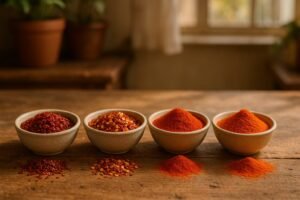
Aleppo pepper is a single-origin Turkish chili, grown in the Maras region of southeastern Türkiye, sun-dried, and coarsely ground. You might also see it called Maras pepper, Halaby pepper, or pul biber. Same chili, different names depending on where the label was printed.
The thing that catches people off guard the first time: the flakes feel oily. They clump slightly, stain your fingers deep red, look nothing like the dry brittle stuff in the pizza shop shaker. That oil is not a manufacturing issue — it’s the natural fat content preserved through sun-drying, and it’s exactly what makes Aleppo behave differently in the pan.
Using Aleppo and red pepper flakes interchangeably is a bit like using a tomato from a garden in August and one from a supermarket in February. Technically the same vegetable. Not the same experience.
The flavour is fruity — somewhere between dried cherry and sun-dried tomato — with a mild tang and a natural saltiness that means you often need less added salt in the dish. The heat builds slowly, like a fireplace warming up a cold room rather than someone flicking a switch.
That’s what everything else gets compared to.
🔥 Aleppo vs Red Pepper Flakes: The Number Nobody Puts on the Label
Here’s the part most recipes quietly skip when they say “substitute in equal amounts.”
Red pepper flakes run 30,000–50,000 Scoville Heat Units. Aleppo runs 10,000–15,000. That’s not a rounding difference — that’s up to three times the heat. And because red pepper flakes are a blend of whatever dried chilies the producer has that season, the number isn’t even consistent. The pinch that was fine last week might clear the room this week. You’ve probably experienced this without knowing why.
Aleppo doesn’t do that. You learn it once, and it shows up the same way every time.
The texture difference matters just as much. Red pepper flakes are dry — they sit on top of food and add heat. Aleppo is oily — it blooms when it hits a hot pan or warm fat, the colour deepens, the aroma opens up, and it becomes part of whatever you’re cooking rather than a garnish on it. Put both in warm olive oil and watch what happens. They are not the same ingredient doing the same job.
The ratio that actually works: 1.5 tsp Aleppo for every 1 tsp red pepper flakes. Going the other direction, cut by half and taste first — you are adding significantly more firepower than you had.
According to Serious Eats, Aleppo’s consistency comes from single-origin processing — the reason it tastes the same every time where blends don’t.
🌿 Aleppo vs Paprika: One of These Is Doing More Work
Using paprika and Aleppo interchangeably is a bit like using tea and coffee interchangeably because both are hot drinks. Technically the same category. Not the same experience.
Paprika is largely about colour. Sweet paprika delivers visual warmth and a quiet earthiness that disappears into a dish without announcing itself. Smoked paprika has more personality, but still very little heat. If you have ever added what felt like a generous amount of paprika and wondered why you couldn’t taste it — that is not a measurement problem. That is paprika doing what paprika does.
Aleppo gives you colour plus heat plus flavour in the same pinch. The deep red is comparable, but what comes with it is the fruity tang and slow warmth that paprika was never going to deliver. If you have been using paprika as a finishing spice and feeling vaguely underwhelmed, Aleppo is the upgrade you didn’t know had a name.
Swapping them the other direction — Aleppo instead of paprika — start at half the quantity. The colour will be similar. The dish will not be.
🌡️ Aleppo vs Cayenne, Chili Powder, and Chilli Flakes
Three comparisons, one honest answer running through all of them: Aleppo is milder than all three on heat, and more interesting than all three on flavour. Whether that trade works depends on what the recipe is actually asking for.
Cayenne is not a fair fight. It runs 30,000–50,000 SHU or higher — sometimes significantly higher. Aleppo tops out around 15,000. If heat is doing structural work in a recipe — a hot sauce, a dish where the burn is the point — Aleppo won’t get there. If you want warmth with something to say for itself, cayenne is too blunt an instrument. They solve different problems.
Chili powder is a different conversation entirely. It is a spice blend — usually cumin, oregano, garlic powder, and some dried chili — not a straight pepper. Swapping Aleppo for chili powder changes the flavour architecture of the whole dish, not just the heat. They are not really in the same category, which is why the swap produces results that surprise people.
Generic chilli flakes are essentially the red pepper flake conversation again. Dry, inconsistent blend, sits on top rather than integrating into the dish. The substitution ratio is the same: 1.5 tsp Aleppo for 1 tsp chilli flakes.
The short version: reach for Aleppo when you want warmth and flavour together. Reach for the others when you need heat alone.
🛒 You Don’t Need a Substitute — It Ships Across Canada
The most common reason people look for an Aleppo substitute is that they have convinced themselves it is impossible to find in Canada. It is a reasonable assumption. It is also wrong.
Edi Gourmet Spice carries Maras Aleppo pepper and ships across Canada for free. If you have been building workarounds with paprika-and-cayenne combinations, you have been doing extra work for a result that is still not quite right. The real thing is a few clicks away — no specialty store required whether you are in Vancouver or Fredericton.
👉 Shop Aleppo Pepper — free shipping across Canada
❓ FAQ
Is Aleppo pepper the same as red pepper flakes?
No. Red pepper flakes are a multi-chili blend running 30,000–50,000 SHU. Aleppo is a single-origin Turkish chili at 10,000–15,000 SHU — milder, oilier, and fruitier. Not interchangeable at equal quantities.
Are Aleppo pepper and pul biber the same thing?
Yes. Pul biber is the Turkish term for this style of coarsely ground dried chili flake — Maras/Aleppo pepper is the variety most commonly used. If a Turkish recipe calls for pul biber, Aleppo is what it means.
What spice is closest to Aleppo pepper?
Nothing is a direct match, but Urfa pepper comes closest — also Turkish, also oily, darker and smokier with a raisin-like depth. Edi Gourmet Spice carries Urfa pepper if you want to compare them side by side.
Is Aleppo pepper like paprika?
Both are red and mild, but that is where it ends. Paprika adds colour and quiet earthiness. Aleppo adds colour, real heat, and a fruity-tangy complexity that paprika doesn’t have.
Can I substitute Aleppo pepper for cayenne?
Not if heat level matters. Cayenne runs up to 50,000 SHU; Aleppo tops out around 15,000. You will get the flavour but not the firepower. If a recipe needs both, use a small amount of cayenne alongside Aleppo rather than choosing one over the other.
What is another name for Aleppo pepper?
Maras pepper, Halaby pepper, and pul biber are all names for the same chili or close relatives. Maras refers to the Turkish region where it grows; Halaby comes from the Arabic name for Aleppo city.
Does Walmart sell Aleppo pepper in Canada?
Yes. Edi Gourmet Spice Aleppo pepper is available on Walmart.ca as a fulfilled product — fast shipping across Canada.
Can I substitute Aleppo pepper for paprika?
Yes, but start at half the quantity. Aleppo has real heat where paprika mostly doesn’t — going 1:1 will make the dish noticeably warmer than intended.
 EN
EN  FR
FR